Class Free Object Oriented Programming
Published on
I used to think that the important innovation of JavaScript was prototypal inheritance. I now think it is class free object oriented programming. I think that is JavaScript's gift to humanity. That is the thing that makes it really interesting, special, and an important language.
Douglas Crockford: The Better Parts – JSConfUY 2014
Tell Me More
I think Douglas Crockford is not only on to something here, but completely right. Let's talk about what it means, why it is hard to grasp for some programmers, and how it can benefit you.
What Class Free Object Oriented Programming Means
First, we need to cover what Object Oriented Programming (OOP) means. There are many types of OOP that are in use today.
Class Based OOP
This is your classical example of OOP. The easiest to understand form is single inheritance. You make a class and inherit from it. And subsequent classes can inherit from that class. One root class, and a tree of classes stemming from there.
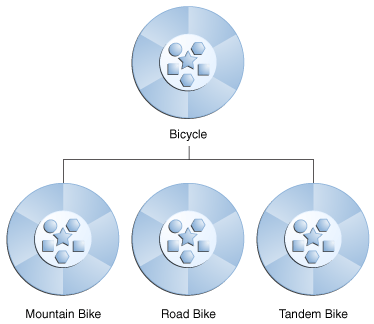
This paradigm is super easy to grasp, but also super easy to create traps for yourself. Like JavaScript, this methodology is full of foot-guns.
A podiatric penetration purposed pistol. A gun which is apparently designed for shooting yourself in the foot.
A Duck, an Alligator, and a Goat
Let's say we want to create a Duck class in this paradigm.
- Inherit from the base
Objectand create anAnimalclass. - Inherit from the
Animalclass and create aDuckclass. - Define
swim,walk,talk, andflymethods onDuck.
Easy right?
But wait a second.
New requirements have come in and you need to define Alligator and Goat now.
- Inherit from
Animaland create anAlligatorclass. - Define
walk,swim, andtalkonAlligator. - Inherit from
Animaland create aGoatclass. - Define
walkandtalkonGoat.
All done! Okay, time to refactor and clean up.
walk, swim, fly, and talk are not specific to those animals are they?
We should probably move them to a shared class to be more DRY.
We should move the methods to Animal so they can be shared among the animals and written once.
Cool, now walk, talk, fly, and swim are written only once!
But wait, Alligator shouldn't be able to fly!
We need an additional class between Animal and the animals to account for this.
Let's create a FlyingAnimal inheriting from Animal so we can account for the Duck that flies.
Oh, and Goat doesn't swim like Duck and Alligator.
So we need to create a SwimmingAnimal to account for that and assign Alligator and Duck to it, but not Goat.
But wait, Duck can't inherit from FlyingAnimal in addition to SwimmingAnimal and WalkingAnimal!
This is why a single inheritance taxonomy is not a good way of organizing our objects in programming. Most of the languages have ways of accounting for this. But to me, they at best feel like workarounds. It is almost certainly possible in all the most common languages, but they really get in the way and require you to write tons of boilerplate to do it.
Class Free OOP
This is where languages like JavaScript really help out.
JavaScript Functions are first-class citizens in the language,
so this method just feels natural and is relatively frictionless.
If you want a Duck, you create a Function that returns an Object that looks like a Duck.
If you also want an Alligator and a Goat, you create those two Functions.
The difference is you do not inherit any classes or implement any interfaces.
Inside the functions, you add methods and properties and return an Object that looks like what you want.
But this time around, when you refactor out the reusable portions,
you just take the pieces out into their own Objects:
withFlying, withAnimal, withWalking, and withSwimming.
Then for each Object that needs the functionalty,
you just copy the methods on them to your own Object.
And if you want to reuse any of them in another object, you just do.
No compiler is going to complain about it or tell you that you can't.
It is just going to work and act like a duck.
Why Class Free OO is Hard To Grasp
It is a Whole School of Thought
Most students in Computer Science or people that have self-taught themselves programming have learned or picked up a popular OO language. Whether that is Java, C#, C++, etc. does not matter. These languages have inheritance built into them and strongly rely on you using their pattern to properly use the language. JavaScript even has its own paradigm of it: Object.prototype.
For many, the current paradigm for handling complexity is by utilizing interfaces and parent classes. This works, but can get hairy when trying to call methods of parents or parent's parents to extend functionality or trying to decide what should be in a class, parent, or interface.
Tools are Geared Around Inheritance
People are too dependent on their OOP focused IDE's to even want to do it another way. Many of the restrictions and constraints of some languages make programming so difficult an IDE is more-or-less required. If I had to program C# code without an IDE, I would probably go nuts. The sheer amount of ceremony, boilerplate, keywords, system libraries, constraints, and gotchas in the language are too much for me to try and program with a text-editor and a compiler. The IDE's offer all these tools for refactoring in an OOP sense it is hard to stray away. Some people spin this as a benefit for the language because it has such an amazing IDE, but I see it as a negative that the IDE is basically required to use the language in a proficient way. The language is so complicated, not even the programmers can trust themselves.
How Class Free OOP Can Benefit You
It actually can't benefit you if your language of choice can't do it in an easy way. But if it is like JavaScript, there are lots of niceties you get out of it. The weirdest thing for me is how simple of a language JavaScript is, yet how flexible it is and how confusing it is to even experienced developers.
But in JavaScript at least, here are some things it gives you:
- Smaller amounts of code
- Simpler code that saves time
- No crazy inheritance/interface graphs
- Easily composable objects
Let's go over those real quickly.
You will write less. You aren't writing boilerplate to define interfaces and figuring out the hierarchy and implementing the functions on the class. You are copying the properties straight to your object. You can sort of view it as multi-inheritance limited to a single level where all of the parents are merely describers.
Your code will be much simpler and flexible. After you're done not writing tons of boilerplate and ceremony, pat yourself on the back for saving that time and being able to see your bugs more easily.
You won't be making any decisions about if your parent's parent's parent class is doing too much or too little. You'll be looking at the immediate thing you included and deciding if it is enough.
Do you have a button that needs rounded corners? Cool, make a rounded-corners object. Do you need a duck that has rounded corners too? Cool, then include your rounded-corners object without worrying about what they were inherited from. Nobody cares about what you do with your objects in your private time.
A Duck, an Alligator, and a Goat Revisited
function newAlligator() {
  var alligator = {
    name: "alligator",
    word: "grrr",
  };
  extend(alligator, withAnimal);
  extend(alligator, withWalking);
  extend(alligator, withSwimming);
  return alligator;
}

function newDuck() {
  var duck = {
    name: "duck",
    word: "quack",
  };
  extend(duck, withAnimal);
  extend(duck, withWalking);
  extend(duck, withFlying);
  extend(duck, withSwimming);
  return duck;
}

function newGoat() {
  var goat = {
    name: "goat",
    word: "baa",
  };
  extend(goat, withAnimal);
  extend(goat, withWalking);
  return goat;
}

var alligator = newAlligator();
alligator.talk();
alligator.swim();
alligator.walk();

var duck = newDuck();
duck.talk();
duck.fly();
duck.walk();

var goat = newGoat();
goat.talk();
goat.walk();

function extend(target, source) {
  Object.keys(source).forEach(function (key) {
    if (typeof target[key] !== "undefined") {
      return;
    }
    target[key] = source[key];
  });
}

var withAnimal = {
  name: "name",
  word: "word",
  talk: function () {
    console.log(this.name + " says " + this.word);
  },
};

var withFlying = {
  fly: function () {
    console.log("flap flap");
  },
};

var withSwimming = {
  swim: function () {
    console.log("splish splash");
  },
};

var withWalking = {
  walk: function () {
    console.log("stomp stomp");
  },
};